
Footwear and Leather Goods Sourcing from India: A Complete Guide for Global Brands
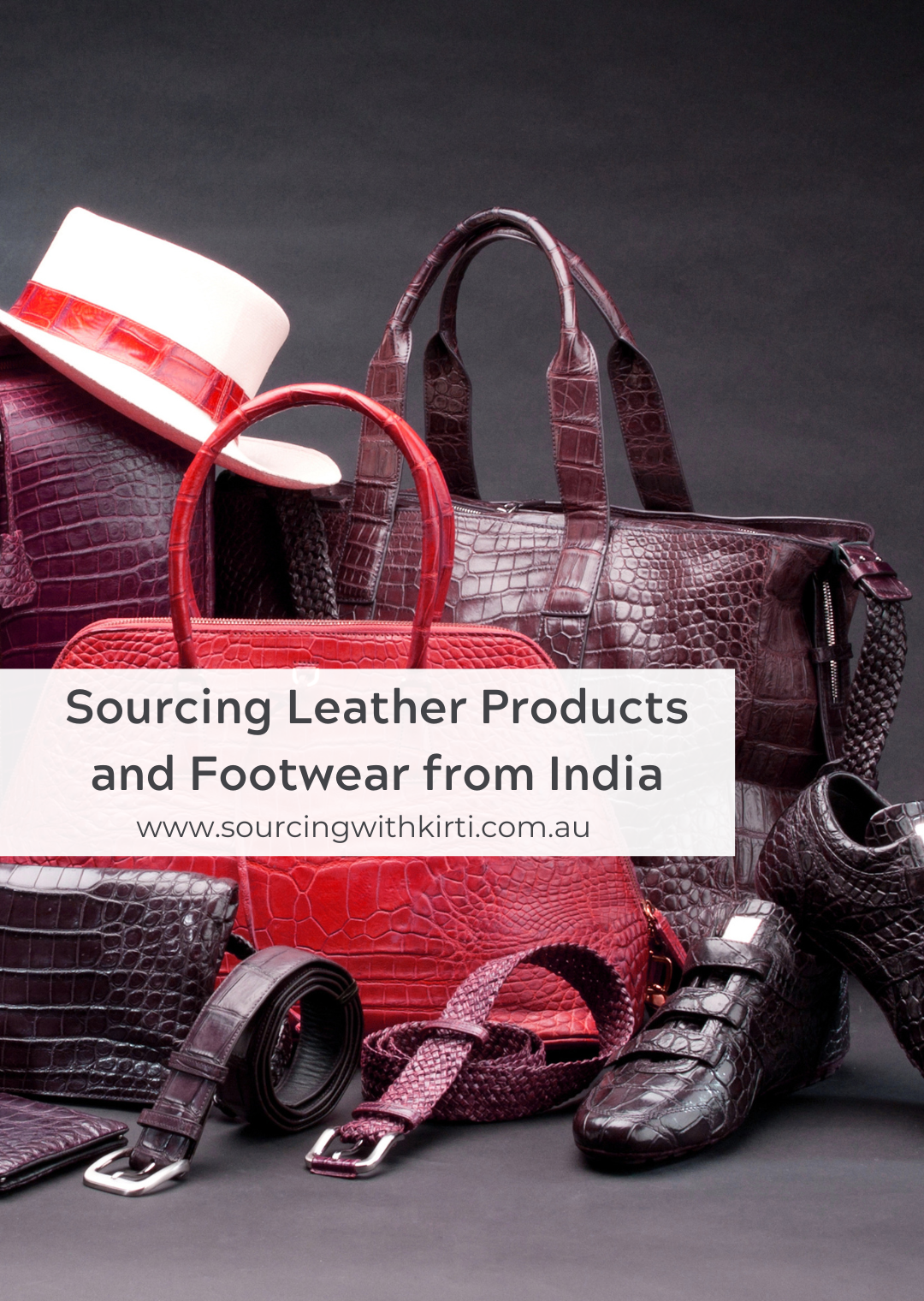
India’s leather industry is one of the country’s largest manufacturing and export sectors, combining traditional craftsmanship with large-scale industrial production. The sector spans the entire value chain, from raw hides and skins to finished leather, footwear, handbags, garments, saddlery, industrial gloves, and fashion accessories. Today, India is recognised as one of the world’s most important leather-producing nations and remains a preferred sourcing destination for international brands seeking quality, scale, and competitive manufacturing costs.
Table of Contents
India’s Leather Industry massive Scale and Structure
The industry’s scale is substantial. According to the Government of India, the leather and footwear sector generates employment for approximately 4.42 million people, making it one of the country’s largest labour-intensive industries. The workforce includes a significant proportion of women and young workers, particularly in footwear manufacturing, stitching, leather goods production, and finishing operations. The sector contributes around 2% of India’s GDP and continues to play an important role in export earnings and manufacturing growth.
India’s raw material advantage is equally impressive. The country possesses approximately 33% of the world’s cattle and buffalo population and around 11% of the global goat and sheep population. This provides manufacturers with access to a wide variety of hides and skins, including buffalo, goat, sheep, and lamb leather, supporting production across numerous market segments ranging from affordable footwear to premium fashion accessories.
A Global Footwear Manufacturing Powerhouse
India is the world’s second-largest producer and consumer of footwear. The country accounts for approximately 11% of global footwear production and produces around 2.6 billion pairs of footwear annually. This production capacity supports both the domestic market and international exports, supplying products ranging from leather dress shoes and safety footwear to sports shoes and fashion footwear.
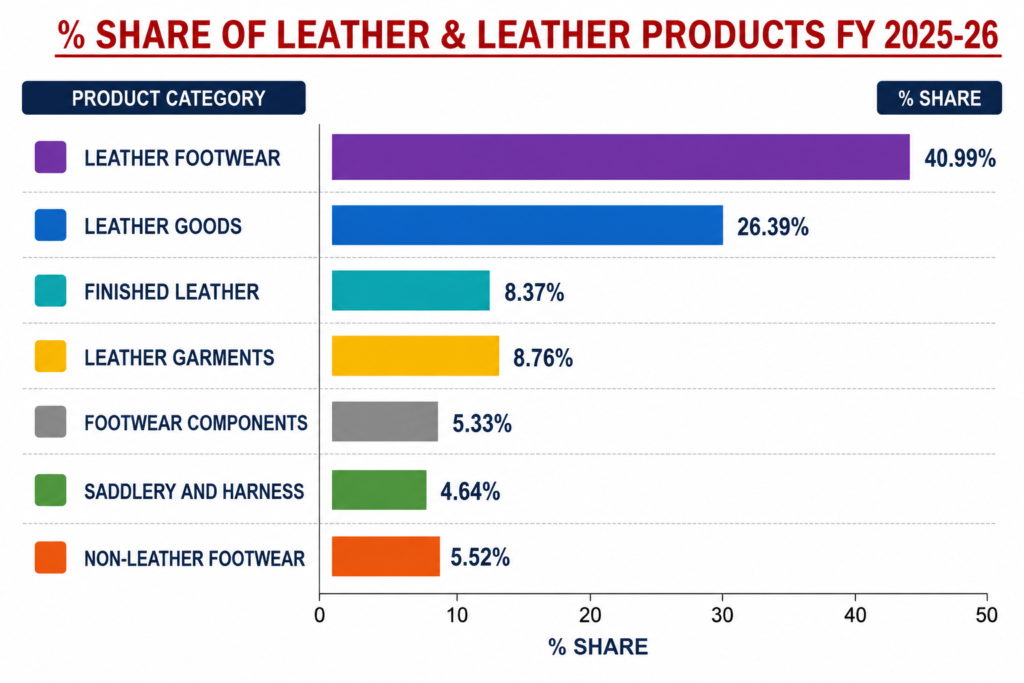
Footwear remains the largest segment within the leather industry. Leather and non-leather footwear together account for more than half of India’s total leather and footwear exports. The sector has benefited from increasing global demand, international sourcing diversification, and growing investments in modern manufacturing facilities.
Export Performance
India exports leather and leather products to more than 50 countries worldwide. Major export destinations include the United States, Germany, the United Kingdom, Italy, France, Spain, the Netherlands, the UAE, Australia, Canada, and Belgium. The United States remains the single largest buyer of Indian leather products, followed by Germany and the United Kingdom. Together, the top export markets account for nearly 80% of India’s leather and leather products exports.
The industry has demonstrated strong export growth in recent years. According to the Council for Leather Exports (CLE), exports of leather, leather products, and footwear reached approximately US$5.7 billion during FY 2024-25, representing growth of around 25% over the previous year. Industry forecasts suggest exports could exceed US$6.5 billion in the coming years as global demand continues to strengthen.
Sustainability and Modernisation
The Indian leather industry has invested heavily in environmental compliance and sustainable manufacturing. Many export-focused tanneries now operate Leather Working Group (LWG) certified facilities, advanced effluent treatment plants, chromium recovery systems, and Zero Liquid Discharge (ZLD) processes. Sustainability has become an important competitive advantage as international buyers increasingly prioritise responsible sourcing and ESG compliance.
Government support has also accelerated modernisation through the Indian Footwear and Leather Development Programme (IFLDP), which includes funding for infrastructure, cluster development, sustainability initiatives, design centres, and skill development programmes. The programme aims to strengthen India’s position as a global hub for footwear and leather manufacturing.
Sources
Top Footwear and Leather Product Categories Exported from India
India’s footwear and leather industry serves a broad range of market segments.
Footwear
- Men’s formal leather shoes
- Goodyear-welted footwear
- Casual shoes and loafers
- Women’s heels and pumps
- Women’s ballerinas and flats
- Children’s footwear
- Sports footwear
- Safety and industrial footwear
- Leather sandals
- Fashion footwear
Leather Bags and Accessories
- Leather handbags
- Tote bags
- Travel bags
- Duffel bags
- Wallets
- Card holders
- Leather belts
- Fashion accessories
Leather Apparel and Industrial Products
- Leather jackets
- Fashion garments
- Leather gloves
- Industrial safety gloves
- Saddlery products
- Equestrian equipment
- Protective leather goods
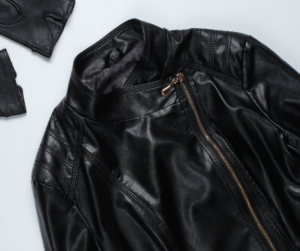
Understanding the Types of Leather Used in India
One of India’s strengths lies in the wide variety of leather materials available to manufacturers. Different leather types are selected depending on the product, target market, durability requirements, and desired finish.
Buffalo leather is one of the most widely used materials in India’s leather industry. It is valued for its durability, strength, and affordability, making it a popular choice for men’s formal footwear, safety boots, belts, travel bags, industrial products, and saddlery. The leather-processing centres of Kanpur and Unnao are particularly well known for their expertise in buffalo leather.
Goat leather has earned India a strong international reputation, particularly in the fashion and accessories sector. Naturally soft, flexible, and fine-grained, it is commonly used in premium handbags, wallets, gloves, fashion accessories, and footwear uppers. Its combination of strength and softness makes it especially suitable for high-quality consumer products.
Sheep leather is lighter and softer than buffalo leather and is widely used in fashion footwear, garments, soft handbags, and small leather goods. Its smooth texture and comfort make it a preferred material for fashion-led products.
Lamb Nappa leather is regarded as one of the premium leathers available from Indian manufacturers. Known for its exceptionally soft feel, smooth surface, and lightweight character, it is frequently used in luxury handbags, premium jackets, designer footwear, and high-end fashion accessories.
Full-grain leather represents the highest-quality layer of the hide and retains its natural grain and markings. Appreciated for its durability and rich appearance, it is commonly used in premium footwear, executive bags, luxury belts, and travel accessories. Many luxury brands favour full-grain leather because it develops character and patina over time.
Vegetable-tanned leather has gained increasing attention as demand for sustainable products continues to grow. Produced using natural tannins derived from plant materials, it is commonly used for artisan belts, luxury wallets, premium bags, and handcrafted leather goods. Its natural finish and environmentally conscious production process make it particularly attractive to premium and sustainability-focused brands.
Major Footwear and Leather Manufacturing Hubs in India
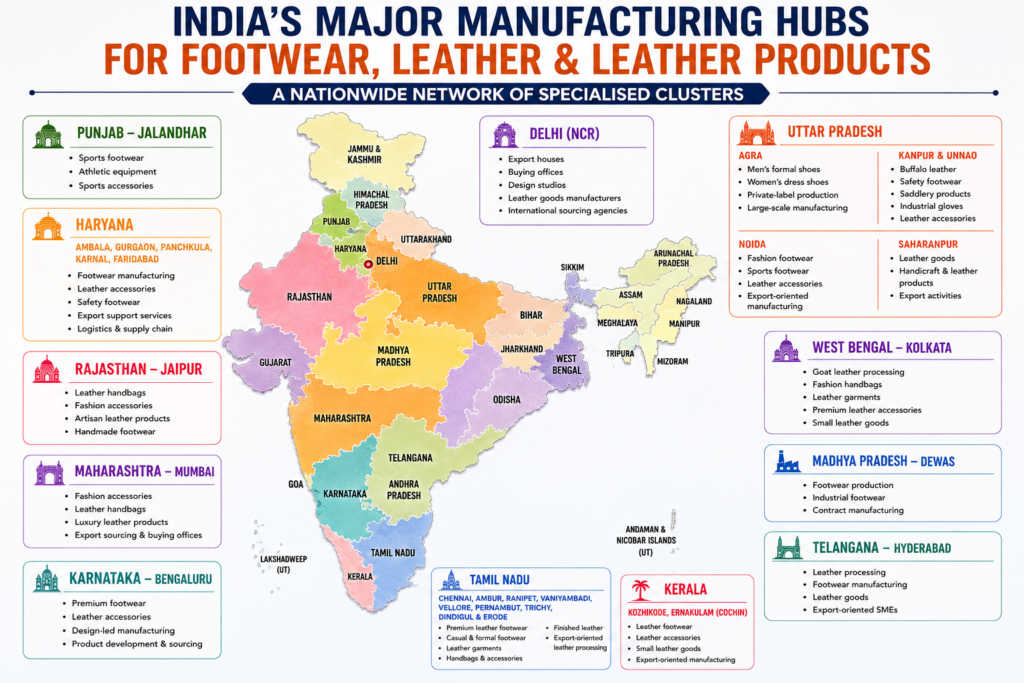
India’s leather and footwear industry is organised around a series of specialised manufacturing clusters, each with distinct strengths in leather processing, footwear production, leather goods, garments, saddlery, and accessories. These clusters have developed over decades, supported by skilled labour, raw material availability, export infrastructure, and extensive supplier networks.
Tamil Nadu: India’s Major Leather Manufacturing Hub
Tamil Nadu is widely regarded as India’s leading leather-producing state and accounts for a substantial share of the country’s leather exports. The state’s leather belt extends across Chennai, Ambur, Ranipet, Vaniyambadi, Vellore, Pernambut, Trichy, Dindigul, and Erode. This region has developed strong expertise in premium leather footwear, casual and formal footwear, leather garments, handbags, leather accessories, finished leather, and export-oriented leather processing. Many internationally recognised exporters, tanneries, and footwear manufacturers supplying European, American, and Australian brands operate within this cluster. Ambur, Ranipet, and Vaniyambadi are particularly known for their concentration of Leather Working Group (LWG)-certified tanneries and export-focused manufacturing facilities.
Uttar Pradesh: Footwear and Buffalo Leather Centre
Uttar Pradesh remains one of India’s most important centres for footwear and leather production. Agra, often referred to as India’s footwear capital, specialises in men’s formal shoes, women’s dress footwear, private-label footwear production, and large-scale manufacturing for both domestic and export markets. Kanpur and nearby Unnao are internationally recognised for buffalo leather processing and have developed strong capabilities in safety footwear, industrial gloves, saddlery, equestrian products, and leather accessories. The region is considered one of the world’s largest buffalo leather-processing centres and has traditionally supplied buyers in Europe and the Middle East. Noida has emerged as a significant manufacturing hub for fashion footwear, sports footwear, leather accessories, and export-oriented production, while Saharanpur, although better known for handicrafts and woodware, also contributes to leather goods manufacturing and exports.
West Bengal: Premium Leather and Fashion Products
West Bengal, particularly Kolkata, remains one of India’s oldest and most established leather manufacturing centres. The city is especially recognised for goat leather processing, leather garments, fashion handbags, premium leather accessories, and small leather goods. Kolkata’s long association with leather craftsmanship has contributed to its reputation for producing premium export-quality products for international markets.
Punjab: Sports Footwear and Equipment
Punjab’s leather and footwear sector is centred in Jalandhar, a city that has developed a strong reputation for sports footwear, athletic equipment, sports accessories, and protective sporting goods. The cluster serves both domestic and export markets and is closely linked to India’s sporting goods manufacturing industry.
Maharashtra: Fashion and Export Trading Hub
Maharashtra plays an important role in India’s leather sector through Mumbai, which functions as both a manufacturing and export-trading hub. The city is known for fashion accessories, leather handbags, luxury leather products, and export sourcing operations. Many international buying houses and sourcing agencies maintain offices in Mumbai, making it an important gateway for global trade.
Karnataka: Design and Premium Manufacturing
Karnataka has developed a strong position in design-led manufacturing through Bengaluru. The city specialises in premium footwear, leather accessories, product development, and design-oriented production. Supported by strong infrastructure and a growing innovation ecosystem, Bengaluru increasingly attracts brands seeking product development and specialised manufacturing capabilities.
Telangana: Emerging Leather Manufacturing Centre
Telangana has emerged as an important centre for leather and footwear production, with Hyderabad acting as the state’s primary manufacturing hub. The city supports leather processing, footwear manufacturing, leather goods production, and export-oriented small and medium-sized enterprises. Continued investment in industrial infrastructure has strengthened Hyderabad’s role within India’s leather supply chain.
Haryana: Footwear and Leather Goods Production
Haryana contributes significantly to footwear and leather goods production through a cluster that includes Ambala, Gurugram, Panchkula, Karnal, and Faridabad. The region is known for footwear manufacturing, leather accessories, safety footwear, export support services, and logistics infrastructure. Its proximity to Delhi provides manufacturers with direct access to international buyers, sourcing agencies, trade fairs, and export networks.
Delhi NCR
Delhi NCR remains one of India’s most important sourcing and export centres. The region hosts a large concentration of export houses, buying offices, design studios, leather goods manufacturers, and international sourcing agencies. Many global brands manage their India sourcing operations from Delhi, making the city a key commercial and coordination hub for the industry.
Madhya Pradesh
Madhya Pradesh has developed a growing manufacturing presence through Dewas, which specialises in footwear production, industrial footwear, and contract manufacturing. The city has attracted investment from manufacturers seeking efficient production facilities and access to central Indian markets.
Kerala
Kerala’s leather sector is concentrated primarily in Kozhikode and Ernakulam (Cochin). The state specialises in leather footwear, leather accessories, small leather goods, and export-oriented manufacturing. Kerala’s strong port infrastructure and connectivity support international trade and facilitate access to overseas markets.
Rajasthan
Rajasthan combines traditional craftsmanship with modern manufacturing techniques, particularly through Jaipur. The city is recognised for leather handbags, fashion accessories, artisan leather products, and handmade footwear. Jaipur’s long tradition of craftsmanship continues to attract buyers seeking distinctive and handcrafted leather products.
India's Manufacturing Marvels
Get an insight into India and Acquire all the knowledge you need to effectively Source your Product from India!

Major Export Markets for Indian Footwear and Leather Goods
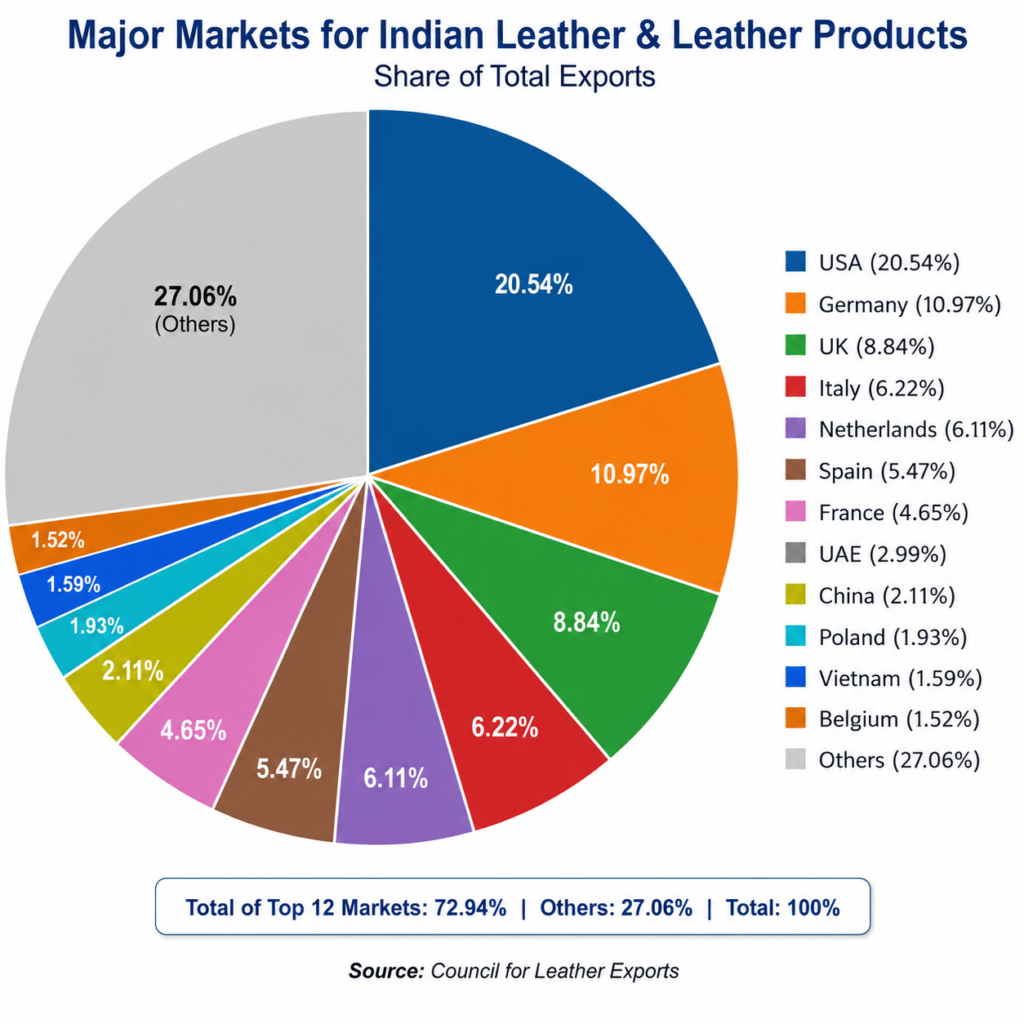
Indian footwear and leather products are exported worldwide, with several markets dominating demand.
European Union
The European Union remains one of India’s largest export destinations for footwear and leather products. Buyers generally require strict compliance with environmental, chemical, and social responsibility standards.
United States
The United States imports significant quantities of Indian footwear, leather accessories, handbags, and safety footwear. Product testing and compliance requirements are often extensive, particularly for children’s products.
United Kingdom
The UK continues to be a major destination for leather footwear, handbags, fashion accessories, and private-label manufacturing programmes.
Middle East and North Africa
Markets across the GCC and wider MENA region import large volumes of Formal footwear, Leather sandal, Safety footwear and Leather accessories.
Compliance, Certifications Requirements
Compliance is increasingly important for global sourcing programmes.
Leather Working Group (LWG)
The Leather Working Group is the world’s leading leather sustainability certification system.
Many international buyers now prefer sourcing from:
- LWG Gold-rated tanneries
- LWG Silver-rated tanneries
REACH Compliance
For European markets, manufacturers often require compliance with REACH regulations governing:
- Restricted chemicals
- Chromium VI
- Azo dyes
- Formaldehyde
- DMFa restrictions
Social Compliance Certifications
Common social compliance standards include:
- SMETA (Sedex)
- BSCI
- SA8000
- WRAP
These audits evaluate labour practices, worker welfare, health and safety, and ethical manufacturing standards.
Quality and Environmental Standards
Many leading exporters also maintain:
- ISO 9001
- ISO 14001
Sustainability Certifications
Depending on the product, buyers may request:
- GRS (Global Recycled Standard)
- Traceability documentation
- ESG reporting support
- Chrome-free leather certification
- Metal-free leather certification
Typical Production Timelines
Although production schedules vary by product category, buyers should generally plan for:
- Sampling: 3–5 weeks
- Production: 6–11 weeks
- Ocean freight: 4–6 weeks
For new product development projects, total lead times from concept approval to warehouse delivery often range between 100 and 140 days.
References
Council for Leather Exports (CLE). Available at: https://leatherindia.org
Invest India. Leather and Footwear Sector. Available at: https://www.investindia.gov.in/sector/leather-and-footwear
India Brand Equity Foundation (IBEF). Leather Industry in India. Available at: https://www.ibef.org/industry/leather-india
Leather Working Group (LWG). Sustainability Standards and Certification. Available at: https://www.leatherworkinggroup.com
Ministry of Commerce and Industry, Government of India. Available at: https://commerce.gov.in
Want us to help you find Best Indian Suppliers for your products?
Click here to find all details about how we can help Find and Connect you to Best Suppliers in India.
If you prefer a more hands-on approach, we also provide online video courses to help equip you with all the information so you can find Best Suppliers in India and have an entire contact directory of suppliers in minutes. Click here to Get all the details about Finding Indian Suppliers Courses.
Looking to Source Products from India?
‘Sourcing with Kirti’, is your comprehensive solution to help you Source products from India. Our Done For You Sourcing services are tailored to offer seamless end-to-end solutions.Click here to get all details about our Sourcing Services.
We also have India Sourcing courses that provide equip you with all information, knowledge, tools, templates and resources to help source products from India.


![Comment Wholesale to Get list of Top wholesale markets in India in your DMs!
Save it for later!
And if you Need our help to Source products from India or connect to suitable suppliers?
Slide into our DM to get started on your sourcing journey. 📥
Get in touch-
✉️ hello@sourcingwithkirti.com.au
🌐 https://www.sourcingwithkirti.com.au
Follow @sourcingwithkirti for product sourcing strategies.
[ e-commerce, sourcing from India, online sellers, online store, small business, clothing brand, fashion, accessories, heritagetextiles india, embroideredclothing, blockprint, mumbai, tiruppur, kolkata, banaras, ludhiana, delhi, jaipur, india, source products from India]#India sourcing, Source from India,#Source products from India, Bestindiasourcingcoach #bestindiaasourcingagent](https://sourcingwithkirti.com.au/wp-content/plugins/instagram-feed/img/placeholder.png)